
Table of Contents
- Dedicated Server vs Cloud for AI Workloads: Quick Comparison
- Performance Consistency and Predictability
- Bare Metal vs Cloud for Machine Learning
- GPU Server Hosting for Deep Learning
- Cost Structures: OpEx vs CapEx and TCO
- AI Infrastructure Scalability Best Practices
- Security, Compliance, and Data Isolation
- When to Choose Dedicated Servers vs Cloud
- Frequently Asked Questions
Last Updated: September 22, 2026
Dedicated Server vs Cloud for AI Workloads: Quick Comparison
The choice in dedicated server vs cloud infrastructure for AI workloads has become one of the most consequential decisions in modern infrastructure planning. According to HostRunway’s 2026 infrastructure trends report, 86% of companies continue to deploy dedicated servers, with 42% of organizations moving workloads out of public cloud in the last year. This shift isn’t random, it reflects a fundamental tension in how teams approach AI infrastructure.
At ServerPronto, we’ve analyzed this decision across hundreds of clients. The real question isn’t which option is universally better. It’s which one solves your specific problem: consistent performance at predictable cost, or maximum flexibility with variable expenses.
Here’s what matters: dedicated servers give you exclusive hardware, full root access, and predictable monthly bills. Cloud platforms offer elasticity and managed services, but at scale, the costs and performance inconsistencies can become problematic. Below, we’ll show you exactly how to evaluate both options against your AI workload requirements.
| Factor | Dedicated Server | Cloud Platform |
|---|---|---|
| Performance Consistency | Predictable, no resource contention | Variable, shared infrastructure |
| Hardware Control | Full customization and root access | Limited, managed by provider |
| Upfront Cost | CapEx investment or monthly commitment | Pay-as-you-go OpEx |
| Scaling Speed | Hours to days | Minutes to seconds |
| Best For | Predictable, continuous workloads | Bursty, variable demand |
Performance Consistency and Predictability
Dedicated servers win decisively on one metric: predictability. When you rent exclusive hardware, your AI model’s inference latency doesn’t fluctuate based on what your neighbor is running. This matters enormously for production systems.
ABI Research’s 2026 data center analysis found that AI workloads are driving massive shifts in infrastructure requirements around power density and cooling, factors that directly impact performance consistency. On shared cloud infrastructure, you’re competing for resources with other tenants. That contention translates to unpredictable response times, which breaks SLAs for customer-facing AI applications.
Bare metal servers eliminate this problem entirely. Your GPU, CPU, and memory are yours alone. No noisy neighbors. No resource throttling. For machine learning inference at scale, especially high-throughput, low-latency applications, this predictability is worth the tradeoff.
Cloud platforms compensate with reserved instances and dedicated host options, but these features push pricing closer to dedicated server costs while still offering less control.
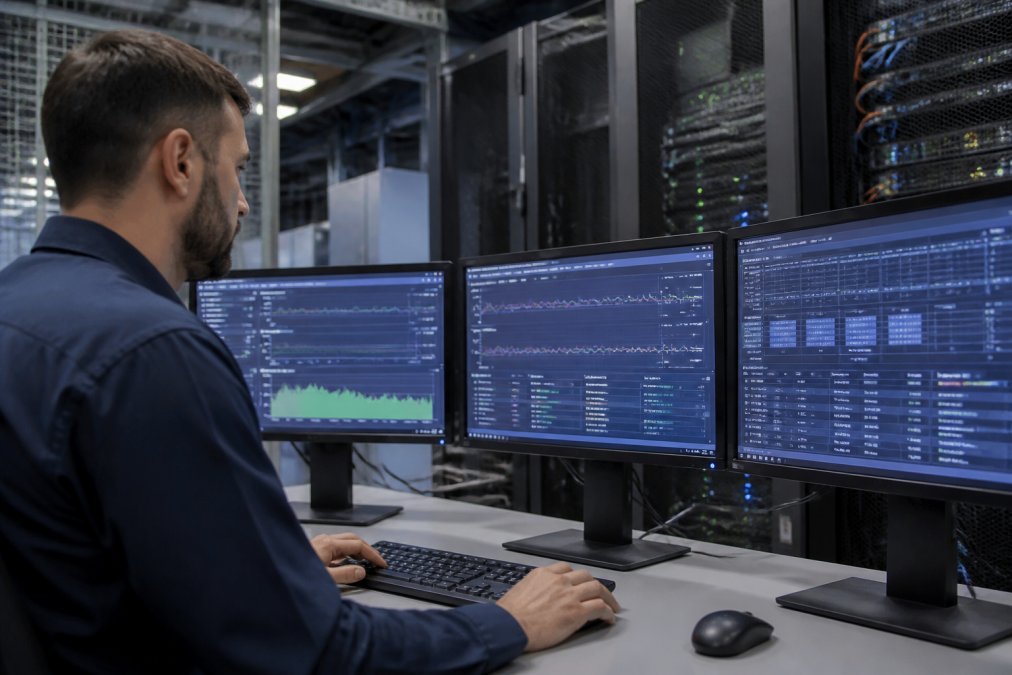
If your AI model serves real-time predictions to customers, performance variance is a business problem, not just a technical one. Dedicated servers eliminate the variance entirely, cloud’s reserved instances approximate this but add complexity and cost.
Bare Metal vs Cloud for Machine Learning
The distinction between bare metal and cloud matters more for AI than for traditional workloads. Bare metal means you’re running directly on physical hardware with no virtualization layer. Cloud means your compute runs on virtual machines, which adds overhead and unpredictability.
For machine learning training, this overhead is tolerable if you’re using GPUs efficiently. For inference, especially distributed inference across multiple models, the overhead becomes a real cost drag. You’re paying for virtualization tax while your models sit idle waiting for network I/O.
Dedicated bare metal servers give you full hardware control. You can configure GPU clustering, tune kernel parameters, and optimize memory access patterns in ways that cloud platforms simply don’t allow. This matters when you’re running frameworks like PyTorch or TensorFlow at production scale.
The research is clear: teams transitioning from hyperscaler public cloud GPU instances to purpose-built colocation or dedicated server environments report improved total cost of ownership and more consistent performance for production-scale AI inference. This isn’t because dedicated servers are inherently faster, it’s because you control the entire stack and eliminate resource contention.
Bare metal gives you root access and full hardware control. Cloud gives you managed services and elasticity. For AI training, you want root access. For experimentation, you want elasticity.
GPU Server Hosting for Deep Learning
GPU server hosting for deep learning splits into two categories: training and inference. The infrastructure needs are completely different.
For training, you need maximum GPU throughput and inter-GPU communication bandwidth. This is where dedicated GPU servers excel. You can provision multi-GPU configurations with NVLink or InfiniBand interconnects that scale to thousands of GPUs. Cloud platforms offer similar hardware, but the per-GPU cost at scale becomes prohibitive.
For inference, the calculus shifts. A single GPU instance serving predictions to thousands of users can run on cloud infrastructure cost-effectively if your demand is variable. But if you’re running inference continuously, 24/7 production serving, a dedicated GPU server with lower per-unit costs becomes cheaper within weeks.
XLC’s 2026 AI server market forecast projects AI server shipments will grow nearly 31% year-over-year, with total spending exceeding $886.7 billion. This growth is driven by enterprises building dedicated infrastructure specifically for AI, not by increased cloud adoption. The market is voting with its wallet.
ServerPronto’s GPU server configurations come with 2-hour provisioning and full root access, meaning you can install custom CUDA versions, optimize PyTorch builds, or deploy specialized frameworks without waiting for provider updates.
Cloud GPU instances charge per hour, even when your model is idle. Dedicated GPU servers come with exclusive access and no contention, a massive difference for production workloads.
Cost Structures: OpEx vs CapEx and TCO
The total cost of ownership (TCO) decision between dedicated servers and cloud for AI workloads requires more than comparing headline pricing. You need a model that accounts for utilization, performance variance, and hidden operational costs.
OpEx Model (Cloud Platforms)
Cloud platforms charge per hour or per second of compute. Cloud platforms charge per hour or per second of compute. The math appears simple:
But this calculation assumes 100% utilization. In practice, cloud workloads experience idle time during model iteration, debugging, and data loading. If your actual utilization is 70%, add 43% to the above figures. If it’s 50%, add 100%.
Additionally, cloud pricing doesn’t account for egress charges (moving data out of the cloud), which can add to total costs for large-scale AI training pipelines. Reserved instances reduce hourly rates, but require 1-year or 3-year commitments and lock you into specific instance types and regions.
CapEx/Monthly Model (Dedicated Servers)
Dedicated GPU servers operate on fixed monthly costs. The per-GPU cost is predictable when amortized across hours per month.
The advantage: this cost is predictable and doesn’t change based on utilization. Whether your GPUs run at 20% or 100% capacity, you pay the same monthly fee.
TCO Comparison Framework
To model your specific workload, use this formula:
AI Infrastructure Scalability Best Practices
Scalability means different things for dedicated servers versus cloud. Cloud scales fast, you can provision new instances in minutes. Dedicated servers scale deliberately, you plan capacity weeks or months ahead.
Hybrid infrastructure works best for teams with both training and inference workloads. Use cloud for training (where you need elasticity), dedicated servers for inference (where you need consistency).
Security, Compliance, and Data Isolation
Security is where dedicated servers create clear advantages. When your AI model processes sensitive data, financial records, health information, proprietary datasets, hardware isolation becomes non-negotiable.
When to Choose Dedicated Servers vs Cloud
The decision framework is straightforward: choose dedicated servers when your workload is predictable, continuous, and performance-sensitive. Choose cloud when your workload is variable, bursty, or requires rapid scaling.
Choose dedicated servers if:
- Your AI model runs inference 24/7 or near-constantly
- You need predictable latency and throughput for customer-facing applications
- Your workload requires full hardware control or custom kernel tuning
- You process sensitive data requiring compliance certifications
- Your TCO calculation favors monthly commitments over hourly metering
Choose cloud if:
- Your AI workload is experimental or research-oriented
- You need to scale capacity up and down weekly or daily
- You prefer managed services and don’t want infrastructure overhead
- Your training jobs are short-lived and variable in size
- You need global geographic distribution with minimal setup
Frequently Asked Questions
Why are dedicated servers often preferred for large-scale AI training?
Dedicated servers eliminate resource contention and provide consistent, predictable performance, critical for long-running AI training jobs. With full hardware isolation and no multi-tenancy, your workload won’t compete with other users’ processes. This translates to reliable throughput and faster model convergence. Additionally, bare metal environments give you root access to optimize kernel parameters and containerization strategies specifically for your compute-intensive tasks, which cloud virtualization overhead can restrict.
What are the cost implications of cloud vs. dedicated servers for long-term AI projects?
Cloud services charge hourly or metered rates, making them economical for variable, short-term workloads but potentially more expensive for continuous, 24/7 operations. Dedicated servers operate on predictable monthly pricing with no overage fees. For production-scale AI inference or training that runs constantly, dedicated infrastructure typically delivers better total cost of ownership (TCO). However, cloud remains cost-effective for bursts, experimentation, and organizations that want to avoid CapEx commitments. The key is modeling your actual workload patterns against each pricing model.
How does GPU virtualization in the cloud affect AI model performance?
Cloud providers often virtualize GPU resources across multiple tenants, introducing latency overhead and resource contention. This reduces peak throughput and can cause unpredictable performance spikes during shared-neighbor load. Dedicated GPU servers eliminate this virtualization layer, delivering consistent latency and maximum GPU utilization for training and inference. For latency-sensitive distributed AI training or real-time inference endpoints, bare metal GPU performance is significantly more stable and predictable than virtualized cloud GPUs.
When should a business transition from cloud to dedicated hardware for AI?
Transition when your workload becomes predictable and continuous. If you’re running AI inference 24/7, training models regularly, or need consistent performance for compliance-heavy operations, dedicated infrastructure typically offers better economics and control. The 42% of companies that moved out of public cloud in the last year did so specifically to regain performance consistency and cost predictability. Dedicated servers also make sense when you require full root access, custom software stacks, or data sovereignty, capabilities cloud multi-tenancy often restricts.
What security advantages do dedicated servers offer for proprietary AI models?
Dedicated servers provide complete hardware isolation, eliminating the risk of cross-tenant data leakage or side-channel attacks. You control the entire security posture, including encryption, access controls, and audit logging. There’s no shared kernel, shared memory, or shared network infrastructure. For organizations handling proprietary models, sensitive training data, or compliance-heavy workloads (HIPAA, PCI DSS), dedicated hardware eliminates multi-tenancy risk and gives you the control needed to meet regulatory requirements and protect intellectual property.




Comments are closed.