
Last Updated: November 4, 2026
Quick Summary
Private cage colocation delivers five core benefits: a locked, floor-to-ceiling enclosure with named access lists for stronger data center cage security, dedicated power and cooling for high-density hardware, 30-40% lower total cost of ownership than public cloud for steady-state workloads, a physical and photographable audit boundary, and pre-agreed recovery sequencing that supports uptime control.
- A cage adds a second physical barrier beyond a locked cabinet in a shared aisle.
- Organizations using colocation and hybrid infrastructure typically realize 30-40% lower TCO for steady-state workloads.
- Confirm the maximum kW per rack a cage supports, not the average across the floor.
- High-density cages often need in-row or rear-door cooling rather than raised-floor perimeter cooling alone.
- A cage gives auditors a named access list, entry timestamps, escort records, and a documented boundary.
Table of Contents
- What Private Cage Colocation Delivers
- Benefit 1: Data Center Cage Security Beyond Shared Space
- Benefit 2: Private Cage vs. Shared Colocation Space
- Benefit 3: Rack vs. Cage Colocation and When to Scale
- Benefit 4: Colocation vs. Cloud for Steady-State Workloads
- Benefit 5: Compliance, Audit Trails, and Uptime Control
- Plan Your Private Cage Deployment with ServerPronto
- Frequently Asked Questions
What Private Cage Colocation Delivers
Private cage colocation is a data center arrangement in which a business rents a locked, floor-to-ceiling enclosure inside a shared facility, giving it dedicated space for its own racks, power, and cabling while still using the provider’s cooling, network, and physical security. Plenty of workloads still run best on hardware you control, but few businesses want to own the building around it. At ServerPronto, we offer private and shared data center space alongside dedicated servers, so we see both sides of that decision.
Below, we break down the five benefits that actually justify the move, plus where each one stops paying off.
Benefit 1: Data Center Cage Security Beyond Shared Space
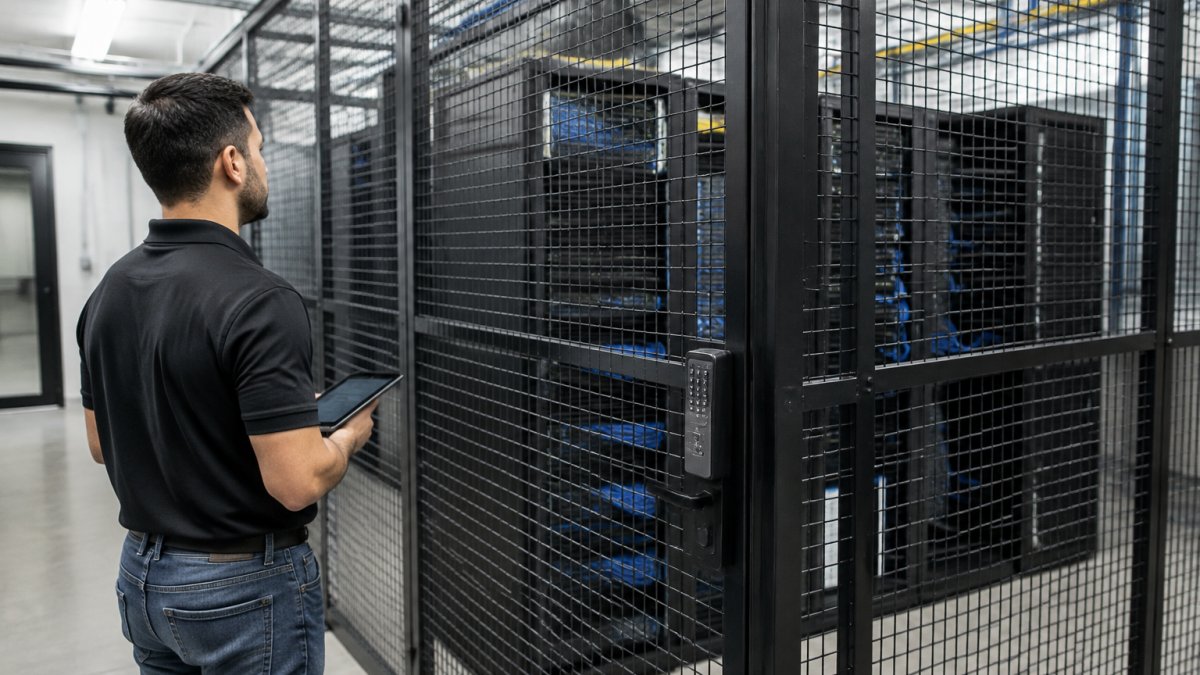
Data center cage security starts with a physical perimeter: a walled enclosure, a locked door, and an access list that names exactly who can open it. Shared colocation gives you a locked cabinet in a common aisle. A cage adds a second barrier, and that barrier is what changes your risk profile.
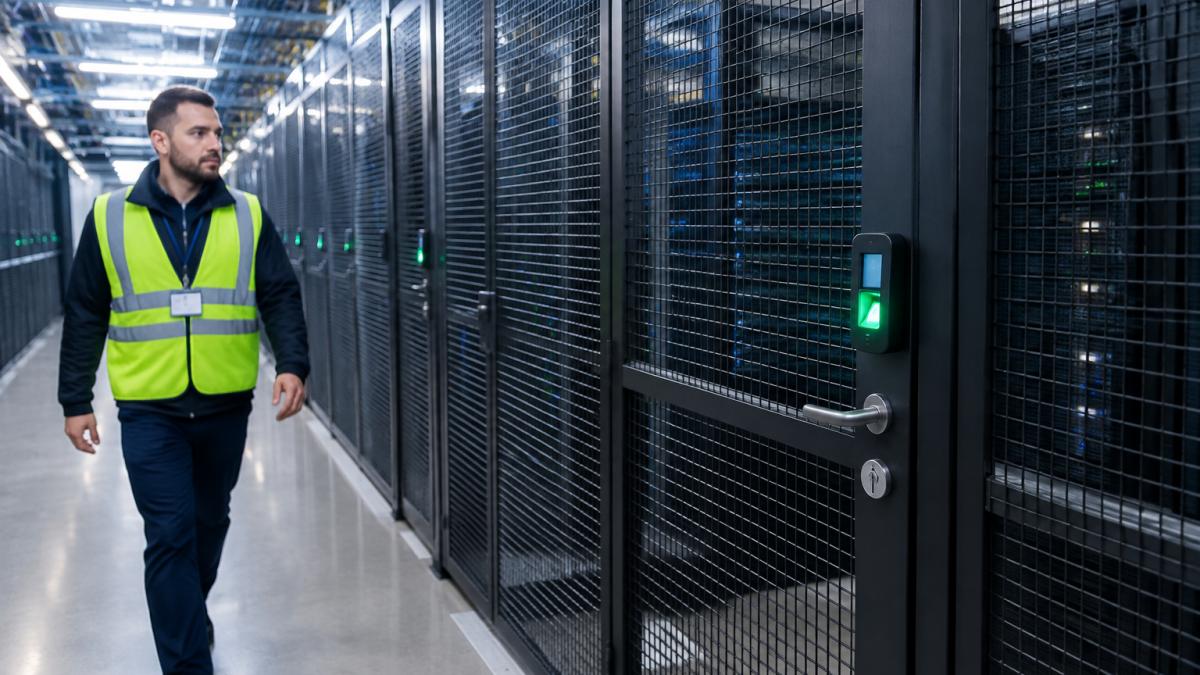
The practical difference shows up in three places:
- Hardware isolation. No other tenant’s technician can reach your equipment, intentionally or by mistake.
- Access control. Biometric entry and named access lists create a record of every person who entered.
- A defined security perimeter. Auditors can see where your environment begins and ends.
The tradeoff is real, though: a cage costs more than a cabinet, and it only pays off if your hardware or your auditors demand that isolation.
Benefit 2: Private Cage vs. Shared Colocation Space
The private cage vs. shared colocation decision comes down to isolation versus cost. A cage costs more and takes longer to plan, but it gives you walls, dedicated power distribution, and dedicated cooling.
For readers weighing the footprint itself, our guide to colocation rack space cost per month walks through what drives the monthly number. Pricing depends on power density, cage size, and location, so get a quote rather than guessing.
Where shared space wins: a handful of racks, no compliance pressure, and a team that wants to move fast.
Where a cage wins: regulated data, dense hardware, or multiple teams needing separate access.
Benefit 3: Rack vs. Cage Colocation and When to Scale
Rack vs. cage colocation is a question of scale and control, not prestige. A rack holds your servers in a shared enclosure. A cage holds your racks in your own enclosure. You graduate from one to the other when the constraint changes from cost to control, and in 2026, the constraint that changes first is usually power density.
The signals are fairly consistent:
- You need more than a few racks and the cabinet math stops working.
- Compliance or a customer contract requires demonstrable physical separation.
- Multiple teams or vendors need escorted, logged access.
- Power density per footprint climbs beyond what a shared cabinet handles comfortably.
That fourth signal deserves more attention than it usually gets. Modern AI and machine-learning hardware can push power density well beyond what a shared cabinet is built for. A private cage gives you dedicated power distribution, dedicated cooling capacity, and the physical room to run higher-density racks without renegotiating your neighbor’s thermal envelope.
Before you commit, confirm three things with the facility:
- Power per rack. Ask for the maximum kW per rack the cage can support, not the average across the floor.
- Cooling method. High-density cages often need in-row or rear-door cooling rather than raised-floor perimeter cooling alone.
- Growth headroom. Confirm the cage can expand to adjacent space without a full re-cabling project.
Cages carry higher initial complexity than standard cabinet colocation. Layout, access control, and internal infrastructure all need planning up front. Budget for that design phase, because retrofitting a cage layout after move-in is expensive, and retrofitting for density you did not plan for is more expensive still.
Watch out: a cage that meets your current rack count but caps power per rack below your GPU roadmap will force a second move within a year. Size for the density you expect, not the density you have.
Before committing to a cage, confirm these facility specifications up front.
| Item | What to confirm | Why it matters |
|---|---|---|
| Power per rack | Maximum kW per rack the cage supports | Not the average across the floor |
| Cooling method | In-row or rear-door cooling for high density | Raised-floor perimeter cooling alone may not suffice |
| Growth headroom | Cage can expand to adjacent space | Avoids a full re-cabling project |
Benefit 4: Colocation vs. Cloud for Steady-State Workloads
Colocation vs. cloud is not a religious argument, and the cost data is clearer than most debates suggest. According to DataBank’s 2026 enterprise infrastructure analysis, organizations using colocation and hybrid infrastructure typically realize 30-40% lower total cost of ownership than equivalent public cloud deployments for steady-state workloads.
The keyword there is steady-state. Predictable, always-on workloads, like databases, backup targets, and internal applications, fit fixed infrastructure well. Bursty or experimental workloads usually fit cloud better. Most enterprises now run both: private cages for the stable core, cloud for the elastic edge. For a deeper comparison against dedicated hosting, see our breakdown of colocation vs dedicated hosting.
Best for: teams with predictable load and a cloud bill that keeps climbing.
Skip if: your demand swings wildly month to month.
Benefit 5: Compliance, Audit Trails, and Uptime Control
Compliance work gets easier when the physical layer is documented. A cage gives auditors a clear boundary, a named access list, and a visitor log, which is exactly what a compliance audit asks for. Many data center operators design facilities around common compliance frameworks.
The mechanics matter more than the label. In practice, a cage-supported audit trail usually includes:
- A named access list tied to individual identities, not shared badges.
- Entry and exit timestamps for every person who crosses the cage door.
- Escort records for vendors and contractors who are not on the list.
- A documented boundary that separates your environment from other tenants in the facility’s own records.
That last item is the one auditors ask about most. In shared space, the boundary between your equipment and a neighbor’s is a logical one. In a cage, it is physical and photographable, which shortens the evidence-gathering phase of an audit considerably.
Uptime control is the other half. Redundancy in power and cooling, plus a written uptime SLA, turns availability from a hope into a contract term. You can review the commitments behind a hosting plan on our service level commitments page.
Disaster recovery is where the cage advantage is least discussed and most valuable. When a facility event forces an evacuation or a partial shutdown, recovery order matters. Shared-aisle tenants are typically restored on the provider’s schedule, alongside everyone else. A private cage lets you pre-agree a recovery sequence for your own footprint, keep your own spare parts and cabling inside the enclosure, and restore your environment without waiting on a neighbor’s ticket queue. For teams with a defined recovery time objective, that difference is often the deciding factor between a cage and a cabinet.
Watch out: a cage does not fix a weak internal change process. Most outages we see traced back to a configuration change, not the facility, and a cage will not shorten an RTO if your own runbooks are out of date.
Plan Your Private Cage Deployment with ServerPronto
A cage deployment rewards planning. Start with power density, rack count, and access lists, then confirm the facility can meet them before you sign anything.
ServerPronto runs an owned data center with redundant power, carrier-neutral connectivity, and 24/7 on-site technicians. We offer 2-hour provisioning on dedicated infrastructure, full root access, month-to-month billing with no contracts, and a 100% uptime guarantee. If you are still deciding whether the move makes sense, our guide on whether colocation is worth it for small business is the right starting point.
Get started with ServerPronto and build a cage plan that matches your hardware, your auditors, and your budget.
Frequently Asked Questions
What is private cage colocation and how does it differ from a shared space?
Private cage colocation is a fully walled enclosure inside a data center that you rent as dedicated space for your own cabinets and hardware. Unlike shared colocation, where you rent a single rack among other tenants, a cage gives you a locked perimeter, your own access controls, and room to grow. The trade-off is more planning upfront for layout, power distribution, and internal cabling. For teams running regulated workloads or high-density gear, that control is usually worth the extra setup effort.
Is colocation cheaper than cloud for steady-state workloads?
For workloads that run continuously at predictable levels, colocation often costs less over time. Colocation and hybrid infrastructure can offer a lower total cost of ownership than public cloud for steady-state workloads, depending on the deployment. Cloud still wins for spiky, short-lived, or experimental workloads where you need to spin resources up and down. Many enterprises now run a hybrid model, keeping stable databases and AI training clusters in cages while bursting to cloud when demand spikes.
When should a business choose a private cage over individual racks?
Move from racks to a private cage when you outgrow a single cabinet, need stricter physical access controls, or face compliance audits that require a defined security perimeter. Cages also make sense when you run high-density hardware like GPU servers that need dedicated cooling and power distribution. If you are still at one or two racks with low compliance pressure, shared colocation is usually the more economical choice. The decision comes down to how much isolation, auditability, and growth room your workload demands.
Can a private cage colocation environment scale as a business grows?
Yes. Cages are sized in square footage and power allocation, so you can expand within your enclosure or move to a larger one as your server count grows. Providers typically let you add cabinets, circuits, and cross-connects without relocating your entire footprint. That scalability matters for AI and high-performance computing teams whose GPU density climbs faster than a single rack can support. Plan your initial cage with spare capacity so growth does not force an early move.
What security benefits does a private colocation cage provide?
A cage adds a physical layer that shared space cannot match: a locked enclosure, badge or biometric entry, and a documented audit trail of who accessed your hardware and when. That reduces the attack surface because fewer people can physically reach your servers. Many facilities also support cage-level monitoring and dedicated power circuits, which improve fault tolerance. For HIPAA, PCI DSS, or SOC audits, that documented physical control is often a requirement rather than a nice-to-have.
The cage decision is really a control decision: how much isolation your workloads and your auditors actually require. ServerPronto gives you private and shared colocation space, dedicated servers, and GPU environments under one roof, backed by over 20 years in hosting and 24/7 on-site support. Build your configuration and get a quote tailored to your rack count and power needs.







Comments are closed.