

Last Updated: November 7, 2026
Quick Summary
The bare metal vs virtualized decision for high frequency trading comes down to whether you need every microsecond of deterministic performance a physical machine delivers or whether flexibility matters more than the last few hundred nanoseconds. Bare metal gives hardware isolation and predictable latency, while virtualization gives elasticity and lower entry cost per slice. Most modern trading operations choose hybrid: bare metal for the order path, virtualized for research and backtesting.
- Bare metal removes the hypervisor from the latency path, while virtualization adds hops and variance.
- Benchmark tail latency under production load during market hours, not averages on an idle machine.
- Log hypervisor steal time and CPU ready time to separate noisy-neighbor problems from code problems.
- Kubernetes on bare metal delivers lower, more consistent pod-to-pod latency than Kubernetes on VMs.
- Teams that measure total cost including incident cost and engineering time usually find bare metal cheaper for the order path.
Table of Contents
- Bare Metal vs Virtualized Infrastructure: The Core Trade-Off
- Bare Metal vs Virtual Machines Performance: Latency, Jitter, and CPU Contention
- High-Frequency Trading Server Requirements
- How to Benchmark Trading Infrastructure Without Fooling Yourself
- Kubernetes on Bare Metal vs Virtual Machines
- Operational Trade-Offs, Failure Recovery, and Total Cost of Ownership
- Where Each Option Wins: A Decision Framework
- Frequently Asked Questions
Bare Metal vs Virtualized Infrastructure: The Core Trade-Off
The bare metal vs virtualized infrastructure decision for high frequency trading comes down to one question: do you need every microsecond of deterministic performance a physical machine can deliver, or does flexibility matter more than the last few hundred nanoseconds? The global bare metal cloud market was valued at USD 11.7 billion in 2025 and is projected to reach USD 13.6 billion in 2026, according to Grand View Research’s bare metal cloud market report, which tells you where latency-sensitive teams are putting their money.
Here is the trade-off in plain terms. Bare metal is a dedicated physical server where your workload owns the CPU, memory, and network interface outright. Virtualized infrastructure runs your workload inside a virtual machine managed by a hypervisor that shares physical hardware among tenants.
At ServerPronto, we have provided dedicated hardware for over 20 years, and teams that measure before they migrate often find the bottleneck is not where they assumed.
Bare Metal vs Virtual Machines Performance: Latency, Jitter, and CPU Contention
Bare metal wins on latency consistency, but the margin depends entirely on your stack and how you measure it. DataCenters.com’s reporting on bare metal for low-latency trading cites latency improvements of up to 20% to 30% versus virtualized cloud, though that figure comes without a published benchmark methodology, so treat it as directional rather than definitive.
The three variables that actually move your numbers:
- Latency: the raw time from market data arriving to your order leaving. Bare metal removes the hypervisor from that path.
- Jitter: the variance in that latency. Jitter kills strategies faster than raw speed does, because a backtest built on average latency will fail on the tail.
- CPU contention: the hypervisor scheduler deciding your vCPU needs to wait. On a shared host, a noisy neighbor can spike your tail latency without warning.
Hypervisor Overhead and Resource Sharing
Every virtual machine pays a tax. The hypervisor intercepts privileged instructions, schedules vCPU time, and manages memory mapping, and each of those operations adds cycles your trading loop never gets back.
That unpredictability is the real problem. For a deeper look at how dedicated hardware eliminates this class of interference, see our guide to avoiding noisy neighbors on dedicated servers.
Network Path and Packet Processing
Network latency is where bare metal’s advantage compounds. Virtual machines can support these, but the configuration is more constrained and the performance more variable. Explore virtualization with ServerPronto to review hosting requirements, configuration options and support for your environment.
If you are building out the network side, our walkthrough on configuring a private network between bare metal servers covers VLANs, private IPs, and Linux interface setup.
High-Frequency Trading Server Requirements
High-frequency trading server requirements start with clock speed over core count, low-latency memory, and a network path you control end to end. A 32-core VM running at a throttled base clock will lose to a 16-core bare metal box with a high sustained frequency and CPU pinning, every time.
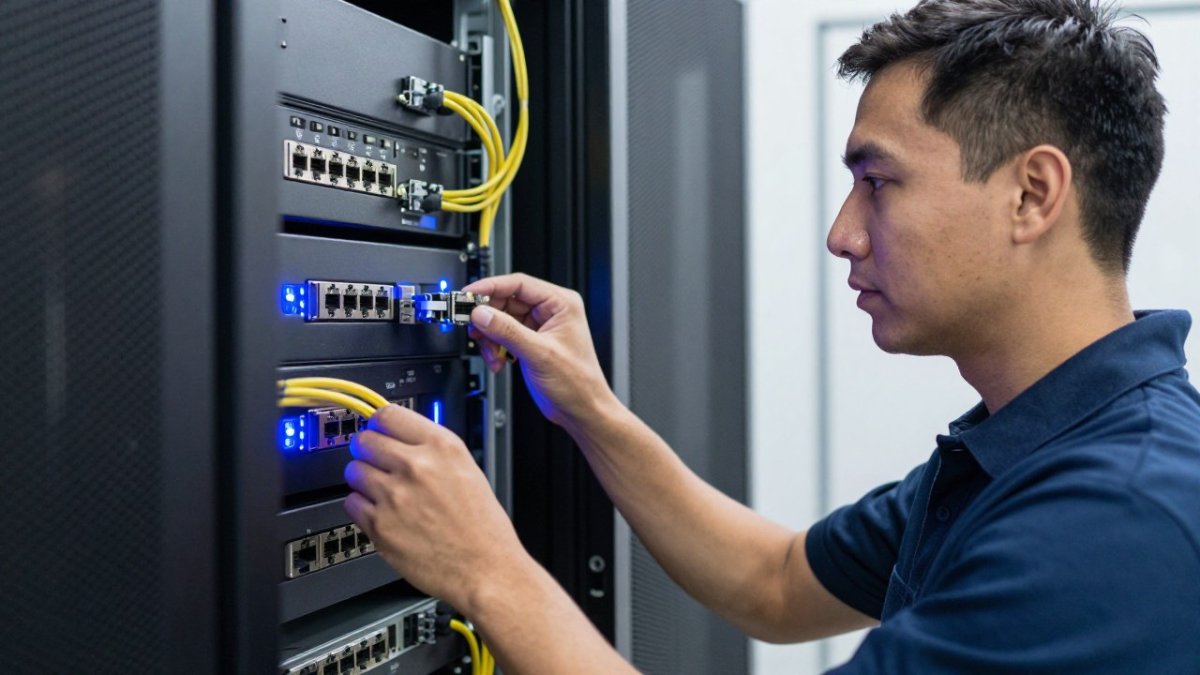
What actually matters for HFT workloads:
- Sustained clock speed, not turbo boost that thermal-throttles under load
- Memory bandwidth and latency, since market data processing is memory-bound
- CPU pinning and core isolation, so your order gateway never shares a core
Hardware and Software Configuration That Matters
Colocation and proximity hosting are often a major latency lever, sometimes larger than the bare metal vs virtualized choice itself. Get the physical distance right first, then optimize the machine.
On the hardware side, compare the dedicated server processors available for your workload before you commit. On the software side, disable power management states, pin interrupt handlers away from trading cores, and keep the kernel as thin as your strategy allows.
How to Benchmark Trading Infrastructure Without Fooling Yourself
Most infrastructure benchmarks are worthless because they measure the wrong thing under the wrong conditions. A reproducible latency benchmark for trading infrastructure must capture tail latency under realistic load, not average latency on an idle machine. Because realistic load alone cannot show whether a system behaves like live markets, benchmark results should be weighed against the execution differences explored by Lux Trading Firm.
What to Measure
- End-to-end tick-to-trade latency. Timestamp market data ingress and order egress on the same clock, ideally with hardware timestamping on the network interface card. Component-by-component numbers add up wrong because they miss queueing and scheduling delays between stages.
- Percentiles, not averages. Report p50, p99, p99.9, and the maximum over the run. The average hides the tail that actually costs money, because a strategy backtested on mean latency will fail the first time a p99.9 spike arrives at market open.
- Jitter as a first-class metric. Compute the standard deviation and the interquartile range of latency samples, and report the worst 1% separately. Jitter is what breaks co-located arbitrage and market-making strategies, not raw speed.
Test Conditions That Make the Numbers Trustworthy
- Run at production load during market hours. A synthetic loop at 3 a.m. tells you nothing about behavior when the feed is saturated and the order gateway is under contention.
- Hold the network constant. Compare bare metal and virtualized instances in the same facility, on the same uplink, with the same switch path. Otherwise you are measuring geography, not virtualization.
- Repeat across multiple days and sessions. One run is an anecdote. Variance across runs, especially across market opens and closes, is the signal.
- Log the full stack. Hypervisor version, kernel version, NIC firmware, BIOS settings, power management state, and CPU governor all belong in the record so results are reproducible.
- Test the failure modes too. Introduce packet loss, NIC resets, and CPU contention deliberately, and measure recovery time. Production incidents rarely happen on a quiet host.
Watch out: benchmarking a VM on a host with spare capacity and calling it representative is the most common way teams talk themselves into a migration they later regret. The same trap applies in reverse when a bare metal benchmark is run with an idle NIC and no competing traffic.
Reading Vendor Claims
When a provider publishes a latency improvement figure, ask three questions: what was the baseline, what percentile is being reported, and was the test run under production load? A 20% to 30% improvement claim without a published methodology is directional at best. The honest comparison is a side-by-side run on your own stack, in the same facility, with the same feed, repeated across sessions.
Kubernetes on Bare Metal vs Virtual Machines
Kubernetes on bare metal delivers lower and more consistent pod-to-pod latency than Kubernetes on virtual machines, because container networking sits directly on the host rather than stacking on a hypervisor virtual switch. The trade-off is operational: you own the control plane, the upgrades, and the failure recovery.
Running Kubernetes on VMs remains the pragmatic choice for teams that value managed node pools and fast scaling.
Operational Trade-Offs, Failure Recovery, and Total Cost of Ownership
Total cost of ownership for bare metal is more predictable than virtualization, even when the per-server price is higher. NetActuate’s comparison of bare metal, virtual machines, and containers notes that bare metal costs more per server than a VM slice, but the absence of hypervisor overhead and the flat monthly bill change the math at scale. The operational differences matter more than the sticker price, and they are where most migrations actually fail.
| Factor | Bare Metal | Virtualized |
|---|---|---|
| Performance predictability | High, hardware isolated | Variable, shared host |
| Provisioning speed | Hours to days, hardware dependent | Minutes, API-driven |
| Failure recovery | Hardware swap, hours | Rebuild or migrate, minutes |
| Redundancy design | You own failover pairs | Provider failover, live migration |
| Observability | Full stack access, you instrument it | Hypervisor layer opaque to you |
| Scaling | Provision new hardware | Near-instant elasticity |
| Cost structure | Flat monthly | Pay-as-you-go |
| Operational overhead | You own the stack | Provider manages hypervisor |
Provisioning Speed and Scaling
Virtualization generally offers faster provisioning, with new VMs often live in minutes through an API. Bare metal provisioning depends on whether the provider stocks configured hardware or builds to order. For latency-critical components that change rarely, that delay is acceptable. For a strategy that needs to spin up 200 backtest nodes before a research sprint, it is not.
Failure Recovery and Redundancy
Failure recovery is a practical consideration with bare metal. A failed disk, power supply, or NIC requires physical intervention, which is why on-site technical support and a clear hardware replacement process matter.
The design answer is redundancy, not faster repair. Latency-critical trading systems typically run active-passive or active-active pairs across separate chassis, with market data feed handlers duplicated and order gateways able to fail over.
Observability and Maintenance
On bare metal you own the full stack, which means you can install kernel-level tracing, hardware performance counters, and NIC-level telemetry without asking permission.
Maintenance windows differ too. Bare metal patching is your schedule, which is good for control and bad for discipline. Virtualized patching is the provider’s schedule, which is good for coverage and bad for predictability during market hours.
How TCO Actually Shifts
At small scale, virtualized infrastructure is cheaper because you pay for a slice and the provider absorbs idle capacity. As latency-critical workloads grow, three costs shift the math toward bare metal: hypervisor overhead that forces you to buy more vCPU to hit the same throughput, noisy-neighbor incidents that cost trading P&L, and the engineering time spent chasing jitter you cannot see.
Where Each Option Wins: A Decision Framework
Use this framework to place each workload rather than picking one infrastructure type for everything.
- Choose bare metal when your strategy is latency-sensitive, jitter-intolerant, and you need CPU pinning, kernel bypass, or direct NIC control.
- Choose virtualized when you need elasticity, fast provisioning for research and backtesting, or you are running non-latency-critical services like dashboards and real-time analytics.
- Choose hybrid when your order path needs determinism but your research pipeline needs scale, which describes most modern trading operations.
Virtualized infrastructure is not automatically the wrong answer, and the research does not support treating it as unsuitable for HFT across the board. Future Market Insights’ bare metal cloud market forecast projects a 20.7% compound annual growth rate through 2036, which reflects growing demand, not the disappearance of virtualized options.
The hard part is not choosing between bare metal and virtualization. It is proving which one your strategy actually needs before you migrate.
Frequently Asked Questions
Does bare metal reduce latency for high-frequency trading?
It can, because a bare metal server removes the hypervisor layer that sits between the workload and the hardware. That layer adds processing steps to network and I/O paths, and it also means other tenants share the physical machine. Measure your own order gateway path before committing to either option.
When should a trading firm choose virtualized infrastructure over bare metal?
Virtual machines make sense for research clusters, backtesting farms, staging environments, and internal tooling where cost flexibility matters more than microsecond latency. Bare metal generally costs more per server than a VM slice, so paying that premium for a workload that never touches the order gateway can waste budget. Keep the latency-critical path on dedicated hardware and let the surrounding systems run virtualized.
How should you benchmark trading infrastructure for a low-latency application?
Measure the full path, not the server in isolation. Timestamp market data as it arrives at the network interface card, through your feed handler, strategy, and order gateway, then out to the exchange. Run sustained tests that capture tail latency and jitter, not just averages, and repeat them at the same time of day. Publish your methodology so results stay comparable, and re-run after any kernel, firmware, or network change.
Is it better to run Kubernetes on bare metal or on virtual machines?
Kubernetes on bare metal gives containers direct access to CPU cores, memory bandwidth, and the network interface card, which suits workloads that need CPU pinning and predictable performance. Virtual machines add a layer of isolation and make node provisioning faster and more elastic. Many firms run the trading path on bare metal and keep orchestration, CI, and batch jobs on virtualized nodes, which keeps the latency-sensitive services away from resource contention.
Can you run a virtual machine on a bare metal server?
Yes. A bare metal server can host a hypervisor and run virtual machines on top of it, which is how private cloud environments are built. The distinction in this comparison is whether your workload runs directly on the hardware or through a virtualization layer. Running your own hypervisor on dedicated hardware gives you control over the configuration, but it reintroduces the overhead that bare metal avoids.







Comments are closed.